Online ticket dismissal course for cyclists
Available for implementation anywhere in the USA and Canada.
For complimentary course access, and to begin the no-cost process for making this available in your jurisdiction, simply complete the form at the bottom of the page.
Since July of 2010, we have been offering an option to cyclists that had been available to drivers for years—having a traffic ticket waived in exchange for taking part in valuable, effective training.
Why offer the Defensive Cycling course to traffic citation defendants?
- Effective means of changing riders’ attitude and behavior.
- No cost to the court or other agencies to implement the program.
- Course participants pay the course fee, along with court fees and any associated costs.
- We handle all administration and interactions with participants.
- Proven content and platform.
- Multiple features to ensure full compliance as required by state education agencies.
- Security features for certificates of completion and their delivery.
- Years of experience in multiple jurisdictions.
Simple implementation requires only the following steps:
- Decide to offer the option to defendants.
- Provide a contact at the court who approves & oversees the program. (Name / position / email address / phone number)
- Provide a contact at the court who will receive certificates of completion via email. (Name / email address / phone number)
- Communicate the decision and details to court staff. (We provide a printable handout in PDF format.)
- Post the option on your court website, and police website if desired. (We provide the content, which you may edit as you see fit.)
One-off instances can be readily accommodated.
Do you have one individual wanting to take the training to dismiss a ticket? Simply provide them with the link to the course and we will take care of the rest.
 Providing this training offers all the benefits of a traditional ‘defensive driving’ course:
- Reduce demands on the courts and police services.
- Improve relations with defendants by providing an education alternative to a fine.
- Decrease the likelihood of repeat offenses.
- Increase road safety.
Created by cycling instructors, for cyclists.
Many jurisdictions offer defendants the option to take a defensive driving course to dismiss a ticket. While there is considerable overlap in the laws governing driving a motor vehicle and riding a bicycle, teaching why and how a cyclist should follow these laws requires specific skills and a different psychological approach.
All course administration is handled by The Center for Cycling Education, including:
- Registrations.
- Payments.
- Inquiries from participants.
- Tracking and verification of course progress & completion.
- Creation of the Certificate of Completion for each participant.
- Confirmed delivery of the certificate to the court via email, with the participant being copied on the message.*
* Should you require that participants deliver their certificate in person or by mail, we can make these arrangements.
By taking this course, participants will:
- Reduce the likelihood of receiving further citations.
- Learn the traffic laws that apply to them.
- Explore the many reasons why they benefit from following them.
- Understand the impact of their actions in traffic.
- Become more cooperative and competent on the road.
- Gain significant skills for riding in traffic.
Exceeds national cycling education standards.
The course significantly exceeds the traffic skills training requirements for the national programs in United States and Canada:
- League of American Bicyclists’ ‘Smart Cycling’ program
- Cycling Canada’s ‘CAN-BIKE’ program
Its content and methodology were modeled after state and provincial government standards for defensive driving courses.
With more than 24 years’ experience as an instructor, the primary course developer has been both a Master Instructor with the League of American Bicyclists and a National Examiner with the Canadian Cycling Association (now Cycling Canada). Others with these credentials, and numerous instructors with each program, helped develop and review the content and delivery.
Highly effective
In a post-course survey, participants have been asked the following questions. Here are the responses to date:
“Has this training influenced you to ride according to the law?”
88% said ‘Yes.’
“Did this training help you feel more confident about cycling in traffic?”
93% said ‘Yes.’
Tested and proven content & platform.
The course was developed in 2010 by The Center for Cycling Education as a classroom offering. This was carried out in conjunction with the Austin Cycling Association (now Bike Austin), the City of Austin Municipal Court, and Bike Texas (the statewide cycling advocacy organization). 70 classroom sessions were conducted before the online course was launched in April 2013.
More than 7400 people have taken the classroom or online course to dismiss a traffic ticket. Many others have taken the online course out of general interest, to gain a pedicab license, or to meet training requirements for their employers. The content is designed to be applicable for cyclists of all experience levels.
The systems used to develop and deliver this training are industry-leading, and we have years of experience in their use and implementation.
For complimentary course access, and to begin the no-cost process for making this available in your jurisdiction,
simply complete the form at the bottom of the page.
Easy for defendants to take part in this ‘ticket dismissal’ option:
(Several versions offer flexibility to align with local needs and, where applicable, fine structures.)
Cost: Ranges from $20 to $40
Duration: 1 to 3 hours
- Complete and submit a Deferred Disposition form through the court, along with the payment of the court fee and any other associated charges.
- Sign up for the online course.
- Complete the course with a passing grade (80%).
- A Certificate of Completion will be prepared and emailed directly to the court, or sent to the participant to deliver to the court (depending on your court’s requirements).
- Once the certificate is processed, the fine will be waived and the ticket dismissed.
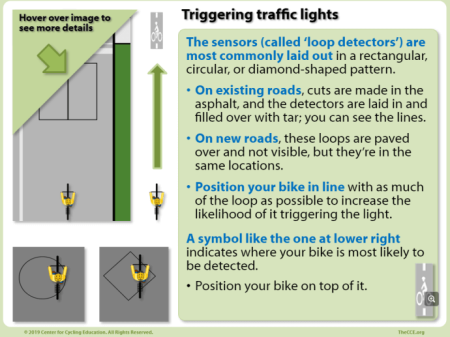
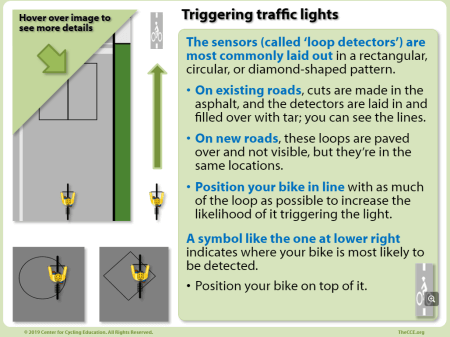
 Trigger an unresponsive traffic light on your bike.
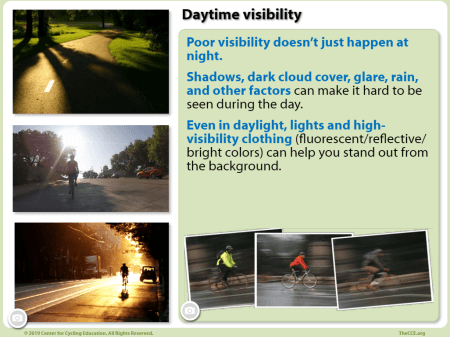
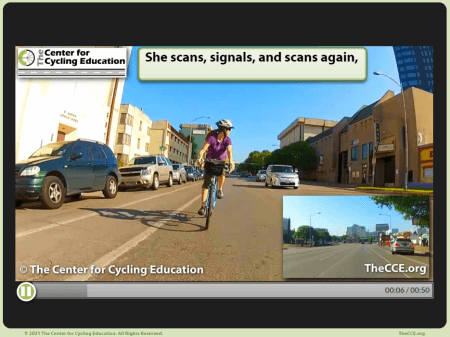
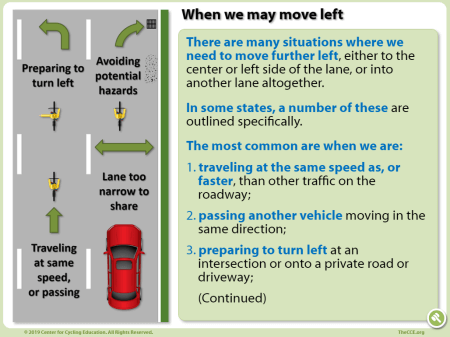
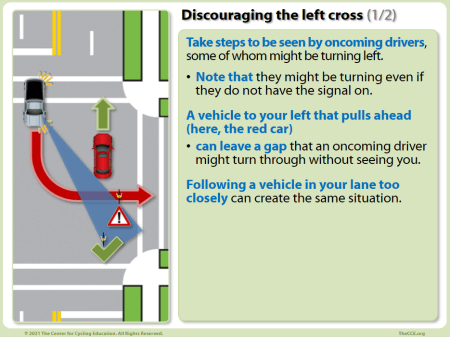
Here is what is explored in the course:
Being an MVP-C
- Maneuverable: Creating space around you
- Visible: Being seen, day and night
- Predictable: Helping others make the right decisions
- Communicative: Getting across the right messages
Equipment
- Optional: Parts of the bike
- Checking your bike for safety
- Sizing, configuring, & adjusting your bike
- Required & optional equipment
- Parking your bike
Bike handling skills
- Braking
- Pedaling at a higher cadence (RPM)
- Riding in a straight line in challenging conditions
- Scanning behind
- Optional: Shifting gears
How people behave in traffic
- Your reaction to other people’s errors
- Video: It’s a 3-Way Street
- How do these behaviors come about?
- Your attitude and its impact
- Monitoring your thoughts
- Evaluating your skills
- Learning from your experiences
Your rights & duties
- Knowing your true place in traffic
- What’s the point of the law?
- An overview of traffic laws
- A summary of common cycling laws
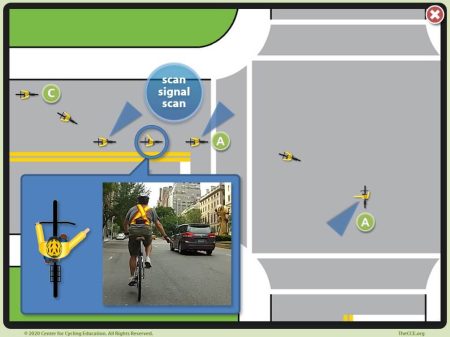
Scanning & signalling
- Scanning for traffic
- Why it’s important
- Review of steps to make it easier / When to scan / Using mirrors
- Signaling
- Why it’s important
- What we need to signal, and tips to make it easier
- Turns / Lane changes / Change of position within a lane / Stops / Pulling onto the roadway / Waving thanks
- How, and how often?
Choosing your place on the road
- Choosing a lane & lane position
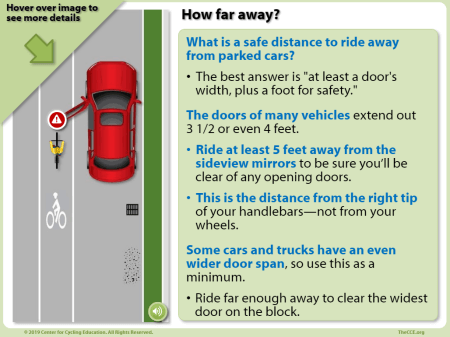
- Parked cars
- Bike lanes
Intersections
- Lane position at intersections
- When stopping is required
- Right of way
- Traffic lights
- Making turns
- Traffic circles & roundabouts
Other riding situations
- on sidewalks
- near buses & trucks
- side-by-side
- on paths & trails
Summary & feedback
- A brief, optional survey lets participants provide input.
Complimentary sections from our courses:
(Links open in new window.)
Traffic skills

Bike handling skills
Equipment

Get complimentary access to the course, and request your jurisdiction’s no-cost participation in this program.
Simply complete the form below, and we will provide you with complimentary access so you may review the course. We will also send you a summary of the simple steps that will allow you to offer this education option to cyclists who are ticketed in your jurisdiction.
Please note that the course enrollment process is done manually. It may take up to a full business day to complete, but we make these requests a high priority. If you need access more immediately, feel free to call or text us at the phone number on our contact page.
To be sure you receive our response to your form submission, please:
• Provide your phone number (optional) so we can reach you if our reply is lost or accidentally deleted.
• Check your spam/junk mail folder.
The form should display directly below. If it is not visible, please
email us at contact@thecce.org, or call/text us at 1 (306) 370-2453.